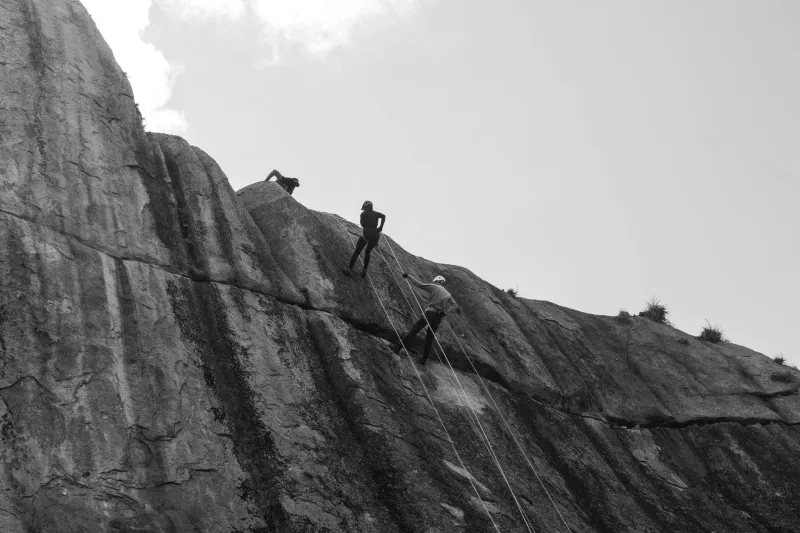
The Return Leg: Why UK Scale-Ups Should Budget for the Way Down

In mountaineering, summit fever describes the moment when ambition overrides judgement. The summit is close, the weather is tolerable and the team presses on, sometimes at the expense of the margin needed to get down. Scale-up leadership has an equivalent condition. The next funding round, headcount milestone or revenue target becomes the fixed point of the plan, while the organisation's capacity to absorb the climb is treated as a secondary concern.
That is not an argument against ambition. It is an argument for completing the route. A growth strategy that stops at the summit is only half a strategy. UK scale-ups operate in an environment that rewards credible ascent narratives: investors want evidence of traction, boards want pace and teams want momentum. Yet the return leg—how the business will consolidate, fund and recover from the push—deserves the same design attention as the ascent itself.
The summit is not the strategy
A descent plan is not a retreat plan. It is the set of decisions that determines how the organisation will convert a hard climb into durable capacity. It covers three forms of weight: cash, people and operational debt. Without it, success at the summit can become the cause of the next crisis. A business that has grown headcount quickly may have added coordination costs faster than management capacity. A business that has won new customers may have accumulated service debt. A business that has raised capital may have bought time without buying the systems that make time productive.
In 2026, UK scale-up boards are rightly attentive to capital efficiency. That attention should not be confined to the fundraising narrative. It should extend to the post-milestone period, when the organisation has to operate at a new altitude.
Cash runway is a descent instrument
Runway is often discussed as a countdown to the next raise. It is more usefully understood as the budget for the descent. A credible plan should state what the business will fund after the milestone: integration costs, hiring lag, systems remediation, customer success capacity and any restructuring needed to simplify the operating model.
This is not a call for excessive caution. It is a call for explicit trade-offs. If the next growth push depends on a twelve-month payback, what happens if payback takes eighteen? If the plan assumes a stable leadership team, what is the contingency if two key roles turn over? A descent plan answers those questions before the organisation is forced to answer them under pressure.
Team capacity after the climb
Scale-ups often plan for the team they need at the summit, not the team they need to get down. The difference matters. Ascent teams are optimised for pace, adaptability and short feedback loops. Descent teams need consolidation, documentation, delegation and the discipline to stop adding complexity.
UK leaders should ask whether the management layer can carry the weight of the next stage without relying on the same few people. If the answer is uncertain, the growth plan is incomplete. Capacity is not simply headcount. It is decision-making bandwidth, managerial coverage and the ability to recover after an intense period.
Operational debt comes due
Operational debt accumulates quietly: manual processes, unclear ownership, deferred hiring, brittle systems and customer commitments that outpace delivery. During an ascent, such debt can look like pragmatism. After the milestone, it becomes a drag on margin and morale.
A descent plan should identify where operational debt is being taken on and how it will be repaid. That might mean sequencing system investment before the next sales push, or limiting expansion until service quality is stable. The point is not to avoid debt altogether. It is to make it visible and affordable.
Governance: put the return leg in the plan
The simplest governance move is to require every growth proposal to include a return-leg section. What will the organisation look like one quarter after the milestone? What must be true for the business to absorb the change? Which decisions will be reversed if the plan slips? Who owns consolidation?
This is a test of strategic clarity. A plan that cannot describe its own descent is probably a wish list with a timeline attached. A plan that can describe it is more likely to survive contact with reality.
A test for leadership teams
Before the next push, leaders can ask three questions. First, if the next milestone arrives but the following quarter is harder than expected, what will we stop doing? Second, which parts of the organisation are already carrying hidden weight, and who will relieve them? Third, what have we learned from previous growth spurts that we are about to repeat?
Summit fever is not cured by pessimism. It is cured by completing the route. For UK scale-ups, the descent plan is not the opposite of growth. It is the proof that growth is under control.