The Interim Peak: Why Early Wins Can Conceal the Harder Climb Ahead

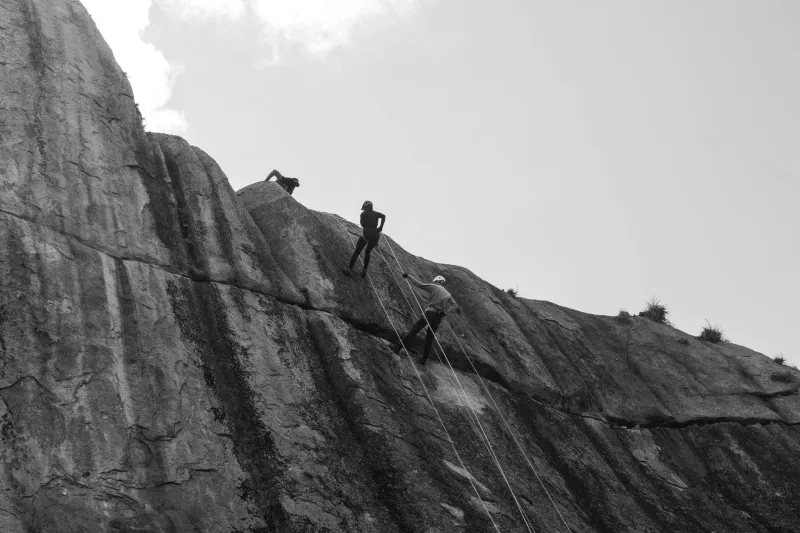
Mountaineers speak of the false summit: the ridge that looks like the top until the cloud lifts and reveals another, higher ridge beyond it. The experience is rarely one of outright deception. It is one of relief, followed by a quiet recalibration. Leadership teams know the feeling well. A growth target is met, a transformation programme reaches its first phase, a newly formed team starts to perform, and the instinct is to plant a flag. The trouble is that the flag often marks a plateau rather than the peak.
The quiet moment after the milestone
The most dangerous point in an ascent is not the exposed traverse or the final pitch. It is the moment when the team believes the hard part is over. In UK boardrooms, this often appears as a subtle change in language. The conversation moves from what we are building to what we have built. The board pack becomes a story of delivery rather than a map of the next challenge. The all-hands meeting celebrates the milestone, rightly, but the next horizon is left vague.
None of this is evidence of complacency in any crude sense. It is evidence of narrative closure. Human beings are drawn to endings, and organisations are drawn to milestones that can be reported. Yet strategy is not a sequence of tidy endings. It is a sequence of provisional summits, each of which changes the view and the conditions for the next stage.
Three tests before the flag goes up
A useful discipline for leadership teams is to pause before declaring victory and apply three simple tests.
The horizon test
Ask what the next meaningful challenge looks like. If the answer is a date on a plan, a budget line or a communications event, you are probably still on the plateau. If the answer describes a new capability, a different customer expectation or a harder operating model, you may be closer to the true summit. The horizon test is not about inventing work for its own sake. It is about distinguishing between completion and arrival.
The capability test
A milestone can be delivered by heroics, by a favourable market or by a small group of exhausted experts. That does not mean the organisation has built something repeatable. The capability test asks a blunt question: can we do this again, at scale, without the same people carrying the same burden? If the answer is no, the milestone is real but the summit is not. It is a base camp from which the next ascent must be properly equipped.
The discomfort test
False summits are often protected by silence. People closest to the work may sense that the next obstacle has not been addressed, but the relief of the milestone makes it awkward to say so. Leaders should therefore ask what conversation the team is avoiding. The presence of discomfort is not a sign of failure. Its absence, at a moment of major achievement, is often the more revealing signal.
Why the plateau is so persuasive
The false summit is persuasive because it offers something leaders rarely get: a clean story. UK organisations operate within reporting cycles, annual planning rhythms and stakeholder expectations that reward visible progress. A milestone provides a legitimate moment to say that the strategy is working. It also provides relief from the pressure that preceded it.
There is a cultural dimension, too. Leadership teams are often recruited and rewarded for delivery. The language of delivery is powerful, but it can crowd out the language of discovery. Once a programme has been declared a success, it takes considerable confidence to ask whether the success has changed the nature of the problem. The plateau feels like a place to rest. In truth, it is a place to re-plan.
The cost of stopping at base camp
The cost of an early flag is rarely immediate. It accumulates quietly. Teams that are told the summit has been reached may stop developing the capabilities needed for the next stage. Transformation programmes that celebrate phase one can lose the urgency required for phase two. Talented people who joined for the ascent may find themselves maintaining a plateau and begin to look elsewhere.
There is also a strategic cost. Markets move, customer expectations shift and operating environments change. A team that has convinced itself it is at the top may interpret new evidence as noise rather than signal. The false summit becomes a fixed position, defended rather than reviewed.
A summit review that earns its name
A practical response is to replace the victory review with a summit review. This need not be heavy. A ninety-minute session with the senior team can cover four questions: What did we actually prove? What did we rely on that may not be available next time? What would have to be true for this to be a plateau rather than a peak? And what is the next provisional summit, with a date by which we will test it again?
The final question matters most. It turns the milestone into a checkpoint rather than a conclusion. It also gives the team permission to keep climbing without undermining the achievement. Celebrating progress and questioning it are not opposites. Mature leadership requires both.
Climbing is a sequence of provisional summits
Strategic clarity is not the art of seeing the final peak with perfect accuracy. It is the discipline of knowing when the view has changed. The false summit is not a failure of ambition. It is a failure of calibration. Leaders who expect the climb to be a single ascent will keep mistaking plateaus for peaks. Leaders who accept that the mountain has several tops will build teams that can recognise the difference, catch their breath and then, with clear eyes, continue.